
Hello perimenopause, goodbye 'good girl'?
Mid-life is a time of opportunity. We are awash with messages that the world is burning, the time for feminine leadership is here. But putting it into practice is not as easy as the instagram reel suggests.
Women in their 60s onwards have fascinated me for the last couple of years. I feel myself inexplicably drawn into the presence of a handful of women who have become teachers, mentors, or friends.
The qualities I see in them are ones I yearn for in myself; those that come with an overall acceptance of self. Not in a showy, performative way. In conversation, what I feel is.... no agenda. It is a relief not bat away the questions constantly bubbling in myself. Questions like 'do I make sense?', 'do I belong', 'am I enough?'. The back and forth in our conversation includes these questions but they are gently explorative and deliberate, rather than an anxious static background.
I suspect it is not that these women have their final answers. Instead, the questions have been met. Perhaps initially with resistance, and then, eventually with love and with curiosity from their own selves. Questions like ‘who am I?’ and ‘who am I becoming’ are gifts to be opened and played with for life, rather than boxes to tick.
A striking thing about my older women mentors is that they never use words that would evoke a finished product, or completion. They are open about their struggles in a way that, initially, I found surprising, conditioned as I've been to always show my best side, and to always be slightly on the defense, as if someone might catch me out as being less than perfect. In turn, I find myself able to share my fears, my experiences with openness. I sense an absence of judgement. It’s irrelevant to the creativity in our conversation.
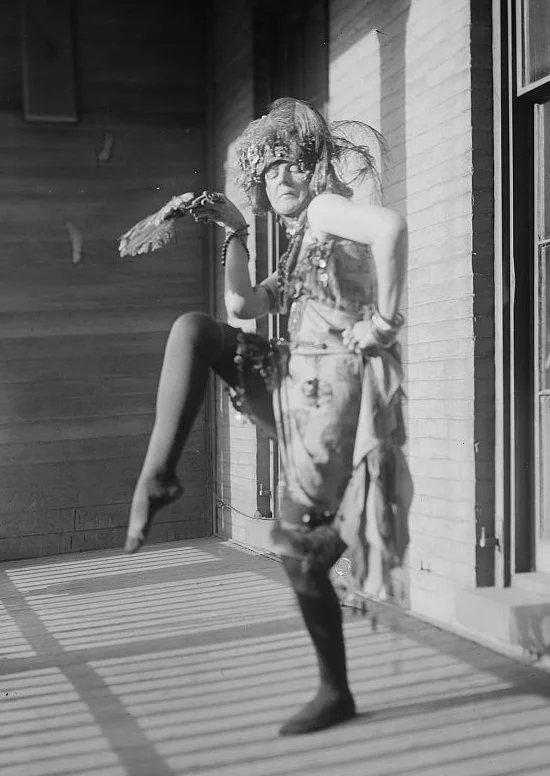
Elsa von Freytag-Loringhoven, a visual artist and poet who used her body to express her rage and disdain for others' expectations of who she could be
When I saw my friend who has recently turned 70 dance in an authentic movement session, dancing purely to express her internal impulses; her movements, her expression, made me weep. I recognize now my tears were about longings I hadn’t fully understood have always been my life passion. A seemingly unquenchable thirst for a world that lets people access self-acceptance, authenticity, and unconditional belonging.
I've become so sensitive to this, I recognise now when I encounter a situation that asks us to replace one set of expectations, with another, as so often happens in counter cultural movements, or self-help spaces; women's circles or similar. (Not all women's circles etc.). But it just shows doesn't it, how easy it is to say the words "authenticity" and "belonging" and yet how right we are to be wary when the words don't match up to experience. And more importantly, how bloody hard it is to actually do.
The spectre of being misunderstood haunts us in mid-life
When I left my job as an academic over two years ago, the questions 'am I enough', 'do I belong' were not gentle whispers, stirring the pot of inspiration, but chaotic, overwhelmingly loud and drenched in 'alarmed aloneness'.
Alarmed aloneness is a term coined by Sarah Peyton, neuroscience educator to describe a nervous system state of extreme distress we experience when we are managing a situation without the reassurance that we are truly seen and heard. As she explains, alarmed aloneness is prevalent in western capitalist cultures that fetishizes self-sufficiency and individualism.
You will recognise alarmed aloneness in the countless moments where you tried to express yourself or you experienced something you found confusing, shocking or difficult - at school, in your family, with your peers - and you were met with scorn, dismissal, judgement, partial understanding, or even no acknowledgement at all.
The pain of alarmed aloneness is relational and if this lack of understanding was experienced daily from a parent or other adult, then this will likely be a thorn in your life that won't be solved by a seminar on imposter syndrome or a self-empowerment checklist. Even if you had warm and reassuring parents, we are still swimming in a culture that seeks to sell us things rather than listen to us.
Alarmed aloneness can rear its head in mid-life because it is a period of your life that marks a shift from external achievement to an internal search for meaning. As you start to reflect on what's important to you, your right brain is in the lead.
Your right brain can imagine a different world; a different direction for yourself. It's where our dreams and longings spring from. It is also the part of our brain which specialises in scanning the environment for danger and processing negative emotional experiences.
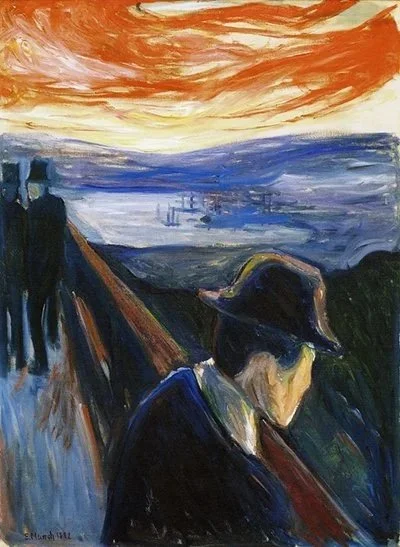
Munch’s Sick Mood at Sunset - Despair. This captures one of the shades of alarmed aloneness.
In moments you are isolated or feel disconnected, the right brain absorbs these cues and amplifies feelings of hurt and rejection so that you never have to feel that again. (And it’s true that every type of activity lights up both the left and right hemispheres but for certain cues, questions and contexts, one side will be 'leading'.)
Just as you start gaining some traction in life in your mid to late 30s, the mid-life quest for meaning may start to pull. But rather than a sense of excited possibility, it can feel like general dissatisfaction or sleepless nights, full body rage or fatigue. And this is in part because all the strategies that helped protect you from alarmed aloneness - humour, deflection, escapism, compromising, perfectionism (yes, all those patterns you're become familiar with).... those strategies may be feeling tired.
The self-expression and longing underneath all the "shoulds" are bubbling away but struggling to blossom because they are also inextricably linked to moments of fear and loneliness. And the most frustrating part can be that you know you want to shift your patterns, and yet you don't know how.
I disappeared because I longed for agenda-less conversations... with myself
At the beginning of my mid-life unraveling, I ended up retreating from the professional networks and activities I was involved in. I desperately needed space.
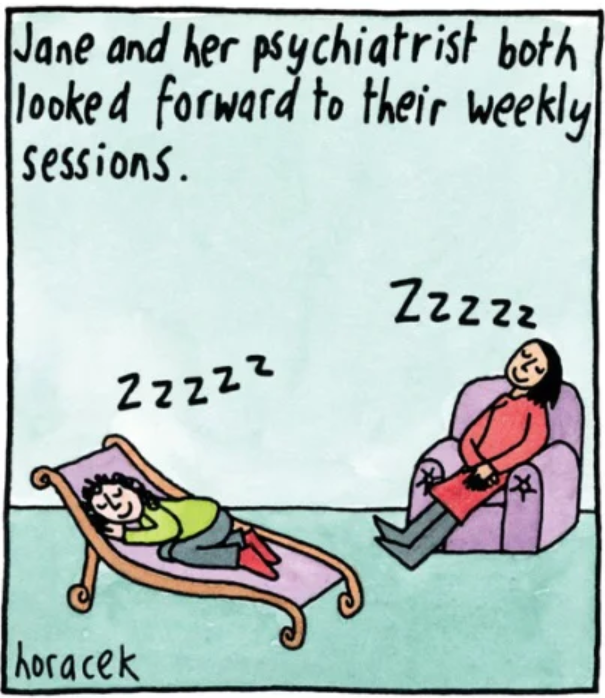
Judy Horacek nails it as usual. Women in mid-life are exhausted and long for rest.
I was thoroughly sick of agendas. Sick of being told what to do. Breathe. Meditate. But in this way. Fix your hormones. Fix your nervous system. Some version of lean in, all versions of the age old idea that women are the problem that need fixing. In many ways, I was caught up in the pattern too. In my quest to feel relief from the grief of self-abandonment, I looked in lots of places for answers. The protective part of me that wanted certainty, peace and order was on high alert. And lots of things helped - modalities and teachers both. I apologize unreservedly to my long-suffering friends that endured my unsolicited enthusiasm about the latest Thing.
In the end, for simplicity I'm going to say that resting in contemplation for what I genuinely felt like doing moment, to moment was one of the most helpful pathways home. As Sharon Blackie described in her dark night of the soul period:
I had never thought of myself as being a particularly creative soul, but I discovered that creativity was a wide-ranging affair. I simply thought about what brought me joy, and I began to cultivate it.
Empowerment culture feeds a protective part of us that mistakenly believes that when we have do the right thing in the right order, we'll be safe and belong. But the soul and the essential self already belongs. The creative spark doesn’t have an agenda. The soul doesn’t tell the artist to pick up a pencil because it reduces cortisol. But instead because it has a felt sense of ‘rightness’ to do so.
The voice that nudges you in particular directions because that is what feels good to do. That's the one to listen to in mid-life. The longings are the path to the next step. And when the longings themselves feel dangerous and terrifying, it might be a sign your protective parts need some resonance; to feel seen and understood. It would start with the lightness you feel when your experience is captured so completely and you relax into the warmth of being understood and of making sense.
Now wouldn't that be nice. You. Make. Sense. The good girl people pleasing doesn't need to be got rid of, or made into yet another thing you are failing to do right as a ‘good feminist’. Neither does your raging part. We could instead gently explore the question, what is it they are longing for? And under that, you might learn what it is that gives you meaning and purpose, and how it is you'd rather be.